
Colposcopy
Access private colposcopy services at Cromwell Hospital in Kensington and Basinghall Clinic in the City.
This webpage was reviewed for clinical accuracy by Miss Hersha Patel, Consultant Gynaecologist.
What is a colposcopy?
A colposcopy is a test used to examine your cervix (the opening of the womb) under a microscope. It’s recommended if a routine smear test reveals abnormal-looking cells.
Abnormal cells aren’t cancer but can become cancerous, so it’s important to get them checked. Your consultant may also take a small sample for testing in a lab.
Occasionally, you may have a colposcopy to check other symptoms, like abnormal bleeding.
You may be recommended a colposcopy if a smear test (cervical screening) found abnormal cells in your cervix.
These cells are caused by human papillomavirus (HPV). They aren’t cancerous at this stage but could become cancerous if left untreated.
You may also be recommended a colposcopy if:
- your smear test didn’t provide clear results
- you have other symptoms, like abnormal bleeding, that require investigation
Why choose us?
At Cromwell Hospital and Basinghall Clinic, we offer:
- top gynaecologists and women’s health experts
- little to no waiting times
- fast access to onward care, if needed
- convenient locations in Kensington and the City
What to expect at your colposcopy
A colposcopy is an outpatient procedure, meaning you’re free to go home straight afterwards. It will take place at either Cromwell Hospital in Kensington or Basinghall Clinic in the City, depending on your preference.
During your colposcopy
A colposcopy is a short procedure, usually taking between 15 and 20 minutes. You’ll be able to go home immediately afterwards.
You will be asked to undress from the waist down and cover yourself with a sheet provided. If you have worn a loose skirt to your appointment, you may be able to keep this on. You will then be asked to lie down and place your feet on the padded support.
Your consultant will place a smooth, tube-shaped tool (a speculum) into your vagina, which helps keep it open. They may also use local anaesthesia to keep you comfortable.
Your consultant will be seated near your feet and will use a tool called a colposcope to examine your cervix. A colposcope is a microscope that helps your consultant see your cervix in detail. The colposcope remains outside the vagina throughout the procedure.
Your consultant will apply a solution to your cervix, which is used to highlight abnormal cells. You may feel a cold or tingling sensation.
Your consultant may also wish to take a sample of your cells (a biopsy), around the size of a pin head. Collecting the biopsy isn’t painful, but you may feel a small scratching or pinching sensation.
After your colposcopy
You can go home immediately after your colposcopy.
If you had a biopsy, you may have some minor cramping, bleeding, and discharge, which should stop within a few days. Discharge may be brown or black in colour, due to the solution used. Occasionally, these symptoms may last longer.
For mild pain, you can take over-the-counter painkillers. If you have severe pain, heavy bleeding, or foul-smelling discharge, you should contact your consultant as soon as possible.
If you had a biopsy, you should not go swimming, use tampons, or have sex for two weeks.
Getting your results
If your consultant didn’t find any abnormal cells, they’ll usually let you know straight away.
If you had a biopsy, your cells will be sent to a lab for testing. Your consultant will let you know when they receive the results.
Depending on the result of your biopsy, you may be offered follow-up treatment to remove any abnormal cells. This prevents them from becoming cancerous.
In rare cases, you may have cervical cancer. If this is the case, you will be referred to a specialist team for support and treatment.
A colposcopy shouldn’t be painful. However, some people may feel more pain than others.
This is what to expect during each part of the procedure:
- Placing the speculum – may feel uncomfortable but not painful, like a pressure sensation
- Applying the solution – may feel like a cold or tingling sensation
- Taking a biopsy – may feel like a scratching, pinching, or cramping sensation
If you’re worried about pain, your consultant can use a local anaesthetic for your procedure. You can also take over-the-counter painkillers afterwards.
It is possible to have a colposcopy while on your period. However, you should let your consultant know beforehand, as heavy bleeding may make it more difficult for them to see your cervix clearly.
You won’t necessarily need a colposcopy if you have HPV. However, you will need a colposcopy if:
- your smear test shows abnormal cells
- you have had two smear tests in a row that showed the HPV virus was present
- you have a high-risk type of HPV
In rare cases, you can develop an infection after your colposcopy. You should look out for the following symptoms:
- a fever or high temperature
- thick, foul-smelling discharge
- severe pelvic pain that doesn’t improve after taking painkillers
- heavy bleeding (enough to soak a pad within an hour)
If you have any of these symptoms, contact your consultant as soon as possible.
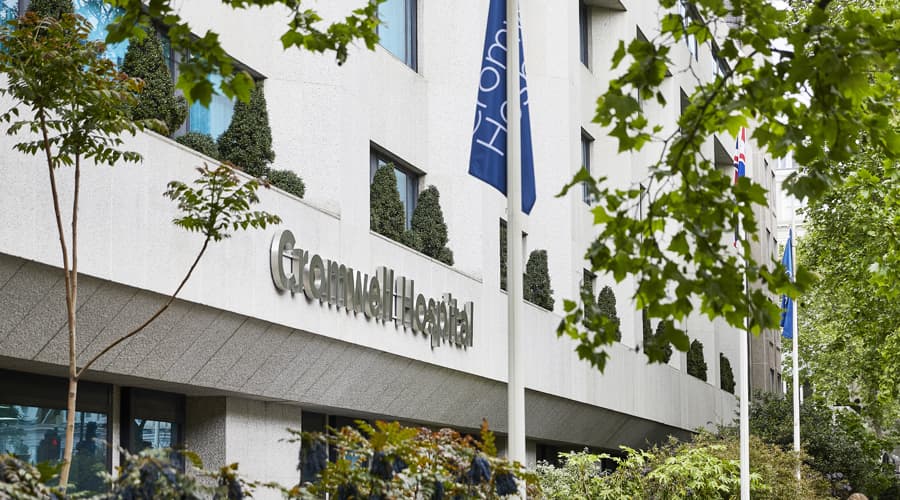
You can have a private colposcopy at either Cromwell Hospital in Kensington or at Basinghall Clinic, an outpatient centre in the City of London.
Our locations

Our team will be happy to answer any questions and book your appointment.
Self-pay: +44 (0)20 7244 4886
Insured: +44 (0)20 7460 5700
Book an appointment today
Call us now for appointment bookings, general queries, and personalised quotes.
Alternatively, you can contact us using our online form.