
Lung cancer

Lung cancer is the third most common type of cancer in the UK. Unfortunately, lung cancer is also the most common cause of cancer death, which is why it is important to detect it early.

At a glance

What is lung cancer?

Lung cancer is the third most common cancer in the UK. Primary lung cancer begins in the trachea (windpipe), main airway (bronchus), or lung tissue. Cancer that has spread to the lungs from elsewhere in the body is known as secondary lung cancer.

There are two types of lung cancer: non-small-cell and small-cell. The treatment you receive depends on what type of cancer you have.

Non-small-cell lung cancer (NSCLC) is the more common of the two, accounting for around 80 - 85% of cases. There are different types of NSCLC, but the main two are adenocarcinoma and squamous cell carcinoma.

Small-cell lung cancer (SCLC) accounts for around 10 - 15% of cases and often spreads quickly to other parts of the body.

Most cases of lung cancer are caused by smoking. If you are a heavy smoker, or have been in the past, you should have a lung cancer screening to monitor your lungs.

However, it is important to note that the incidence of lung cancer is increasing in patients who have never smoked. Often, lung cancers that develop in people who have never smoked have specific mutations (genetic changes). There are targeted drug therapies available for these types of cancer.

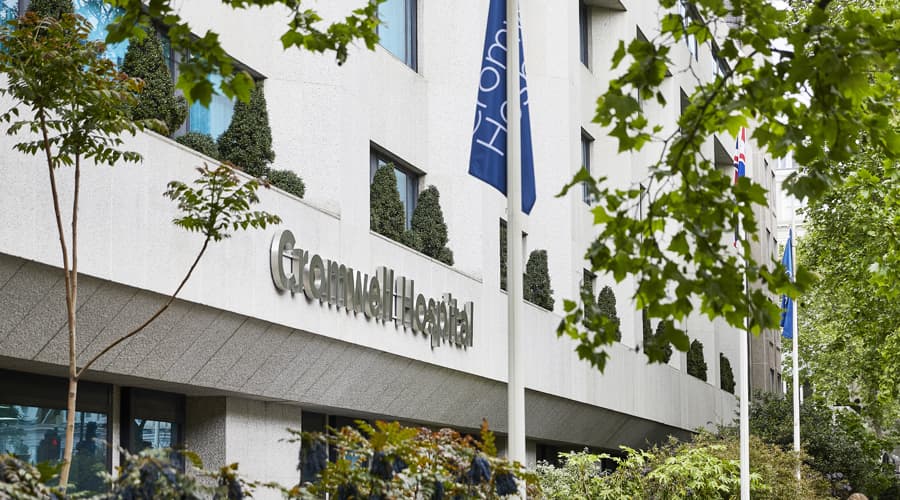
Our cancer hospital in London provides state-of-the-art facilities and advanced treatment for patients diagnosed with lung cancer.

Anyone can develop lung cancer, but you may be more at risk if: 

  • you are over 50 years of age 
  • you smoke tobacco 
  • you have been exposed to chemicals such as asbestos, silica, and diesel exhaust fumes 
  • you have been exposed to radon gas 
  • you live in an area with high levels of air pollution 
  • you have another lung disease, like COPD 
  • you have a family history of lung cancer

Lung cancer symptoms include: 

  • persistent coughing 
  • breathlessness 
  • coughing up blood, or phlegm with blood in it 
  • an ache or pain in the chest or shoulder 
  • persistent chest infections 
  • unexplained fatigue  
  • loss of appetite and weight loss

Many people do not display symptoms in the early stages of lung cancer. 

Lung cancer screening

If you are over 50, currently smoke, or have a history of heavy smoking, you should have a lung cancer screening. 

Our service provides a comprehensive overview of your lung health and includes a consultation with a respiratory expert, a low-dose one-part CT scan, and your results assessed by our multidisciplinary team.

More about lung cancer screening >

Diagnostic tests for lung cancer

If your GP suspects that you may have lung cancer, you will be recommended some of the following tests.

If your consultant identifies a concern during your lung cancer screening, you will be advised to undergo a test called an endobronchial ultrasound (EBUS).

EBUS is used to investigate abnormalities within the lungs. It can help confirm the presence of cancer, the size of the cancer, and whether it has spread (metastasised) to other areas of the body.

The test uses a small, flexible tube called a bronchoscope, which is fitted with an ultrasound probe. The bronchoscope is guided into the airways through your mouth or nostril. If required, your consultant will also be able to take a tissue sample (biopsy) to be tested at a lab.

EBUS is usually carried out under local anaesthetic with an optional light sedation to help you relax. If you are very anxious, it can also be carried out under general anaesthetic.

A chest X-ray is usually the initial test used to look for suspected lung cancer.

If a tumour is present, it presents as a white-grey mass on the scan. However, it is impossible to differentiate between lung cancer and other conditions, so further tests are required for a full diagnosis to be made.

More about X-ray >

A special type of CT scan, called a CT scan with contrast, is often used for diagnosing lung cancer.

For a CT scan with contrast, you will be injected with a contrasting agent, which helps create highly detailed images of your lungs. Sometimes a biopsy is performed at the same time as a CT.

More about CT scan >

This type of scan may be used after you are diagnosed with lung cancer, as it helps your consultant assess where the active cancer cells are and the best method of treatment.

More about PET-CT scan >

You may be recommended an MRI scan if it is suspected that your cancer has spread.

More about MRI scan >

Lung cancer treatment

The type of treatment you have depends on the type of lung cancer you have, its size and location, and what stage it is at. Your general health will also be taken into account.

You may be recommended any of the following treatments:

  • Surgery – used to remove either part or all of the lung. This includes lobectomy, pneumonectomy, and segmentectomy (wedge resection).
  • Radiotherapy – used to destroy cancer cells. External beam radiotherapy is the most common type used for lung cancer. This is often given in combination with chemotherapy.
  • Chemotherapy – a group of cytotoxic (anti-cancer) drugs used to destroy cancer cells.
  • Immunotherapy – a type of cancer therapy used to stimulate the immune system and destroy cancer cells.
  • Radiofrequency ablation – sometimes used to treat early stage non-small-cell lung cancer.
  • Palliative care – used to help relieve the side effects of cancer or cancer treatment.

At our London cancer hospital, your treatment will be carried out within the Integrated Cancer Campus, our internationally recognised oncology department. We provide the latest treatments using state-of-the-art equipment, as well as being home to Europe's most advanced radiotherapy centre with an MRIdian MR Linac.

You will be under the world-class care of some of the UK's most sought-after oncologists, surgeons, and respiratory specialists at our cancer hospital in London.

Non-small-cell lung cancer

If you are diagnosed with non-small-cell lung cancer, your consultant will decide what stage you are at using a staging system called TNM:

  • Tumour – the size of the tumour
  • Node – the location of cancer cells in the lymph nodes
  • Metastasis – whether your cancer has spread.

Small-cell lung cancer

Small-cell lung cancer also uses the TNM staging system, but the most clinically useful definition is:

  • Limited disease – where the cancer is only in the lung, or nearby lymph nodes, and can be treated with radiotherapy
  • Extensive disease – where the cancer has spread to further-away lymph nodes, or other areas of the body, and cannot be treated with radiotherapy.

Paying for your treatment

We welcome both self-paying and insured patients.

Our locations

Contact us today

Our team will be happy to answer any questions and book your appointment.

Self-pay: +44 (0)20 7244 4886
Insured: +44 (0)20 7460 5700

Book an appointment today

Call us now for appointment bookings, general queries, and personalised quotes.

Alternatively, you can contact us using our online form.